Experimental Treatments for SCI:
What you should know if you are considering participation in a clinical trial.
click here.
SCIRE
Now available online:
click here.
|
ICORD website notice
ICORD Please note, we are currently upgrading our web server. During this time, some features of the ICORD website may not be fully functional. We hope to have the system fully restored shortly. We thank you for your patience during this time. If you are having trouble finding a specific item, please call our administrative office (1.604.822.2673).
Welcome to ICORD
ICORD (International Collaboration On Repair Discoveries) is an interdisciplinary research centre for the development of effective strategies to promote functional recovery after spinal cord injury. This unique initiative brings together spinal cord injury researchers from the Sciences, Medicine, Surgery, Rehabilitation, Engineering, Education, and community-based Humanities research. ICORD is working to facilitate the discovery and implementation of relevant solutions to improve functional recovery, mobility, community integration and quality of life for people with spinal cord injury.
ICORD at a glance, 2006/7
|
|
 |
| News | |

Rick Hansen Wheels In Motion Raises $100,000 in Vancouver and over $2 million across Canada
Despite the dreary Vancouver weather, on Sunday, June 8th, 2008, Lower Mainland supporters came out to the PNE and raised close to $100,000 for solutions that improve the quality of life of people with spinal cord injury. Across Canada, Wheels In Motion raised over $2 million. A big thanks to all ICORD members and supporters who came out to support this great and meaningful event.
To learn about Wheels In Motion, click here
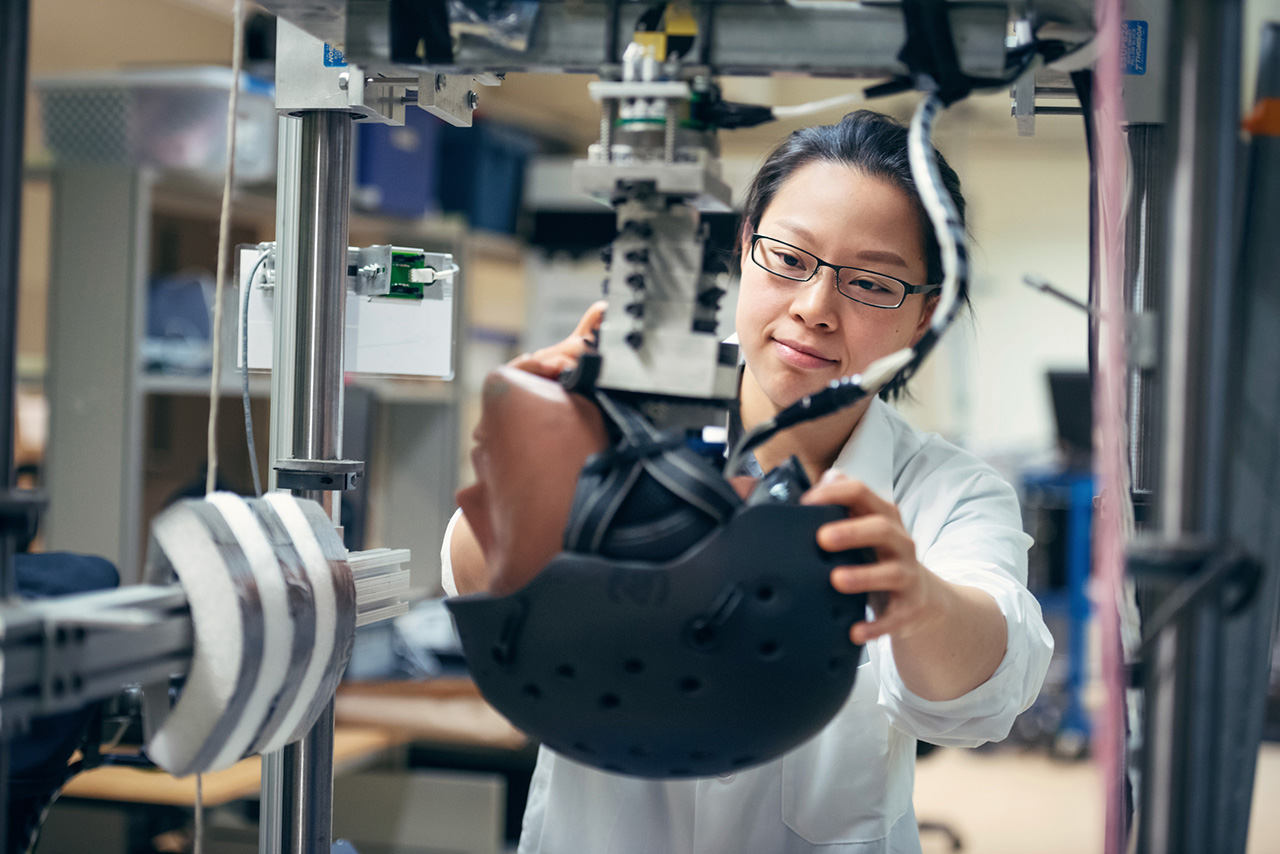
ICORD researchers invent helmet that significantly reduces forces to neck during head-first impact.
ICORD researchers, Dr. Peter Cripton, Director of the UBC Injury Biomechanics Laboratory, and PhD candidate, Tim Nelson, have invented a sports helmet that reduces direct impact to the neck by up to 56 per cent, according to preliminary tests. Dubbed Pro-Neck-TorTM, the patent-pending technology features a movable inner shell that guides the head to tilt slightly forward or backward in a head-on impact, thus allowing dissipation of direct loads to the cervical spine. The inner shell mechanism is deployed only when the wearer lands head-first with a certain speed and angle at impact. It works otherwise like existing sports helmets.
Click here to read the official news release.
Click here to visit the Pro-Neck-TorTM website and learn more about this new invention.
Spanish and German translations of the Guidelines for Experimental Treatments for SCI now available online.
SCIRE: Spinal Cord Injury Rehabilitation Evidence - available online.
 |
| Announcements | |
Job posting: Postdoctoral Fellow or Research Associate position in Autonomic Research and Cardiovascular Physiology A two-year, full-time Postdoctoral Fellow or Research Associate position in Autonomic Research and Cardiovascular Physiology is available with International Collaboration On Repair Discoveries (ICORD) at the University of British Columbia. The successful candidate will be expected to perform research in the area of human cardiovascular autonomic control following spinal cord injury (SCI).
Click here to learn more.
Job posting: Research Associate Position at ICORD in the area of functional genomics and proteomics of severe spinal cord injury models
A two-year, full or part time Research Associate position is available with ICORD (International Collaboration On Repair Discoveries) at the University of British Columbia. The Research Associate will join a research group working on the functional genomics and proteomics of severe spinal cord injury models.
Click here to learn more.

|